🔵 TEXOUHQUI TEZCATLIPOCA — HUITZILOPOCHTLI
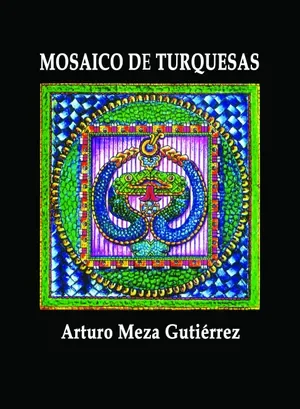
THIS BOOK IS WRITTEN IN SPANISH. WORKING ON ENGLISH TRANSLATION.
Huey Tlahtokan Notes
Mosaico de Turquesas is the foundational text of Mexica philosophical and scientific thought in the modern era. In twenty rigorously researched chapters, Maestro Arturo Meza Gutiérrez dismantles five centuries of colonial mistranslation and reveals the authentic cosmological framework of the ancient Mexica — not as mythology or religion, but as a complete and sophisticated science of existence. At its core is Ometeotl, the dual generating principle, and the Nahui Tezcatlipoca — the four cosmic functions that ancient Mesoamerican civilization studied, encoded, and applied across every field of human knowledge, from psychology and medicine to astronomy and mathematics.
The chapters move through this system piece by piece: the dual expression of Huehuetlahtolli (the ancient word), Tlaltecuhtli and Tlalcihuatl as Father-Mother Earth, the transmuting nature of duality itself, Mictlan and Moyocoyani as expressions of Ometeotl, Tloquenahuaque as the ordering of time and space, and the feminine essence carried through Xochiquetzalli, Chantico, and Mayahuel — closing on the mosaic of turquoise itself as the ancestral thread binding the whole system together. Written as a direct companion to Meza's earlier Cauhpohualli, the two works together form the fuller architecture underlying everything he wrote afterward, including Mosaico de Jade.
This is not an introductory text — it rewards the serious reader who is ready to encounter one of the most profound knowledge systems ever developed by human civilization, presented in its own language, its own logic, and its own scientific precision. Required reading for anyone seeking to understand the true intellectual heritage of Indigenous Mexico beyond the distortions of conquest.
From the Publisher
Mosaico de Turquesas reveals the essence of Nature and of the Human Being from the perspective of the native Philosophy of Duality. From this, Ometeotl is recognized as the Supreme Principle, masculine and feminine, the Father and Mother of all that exists, giving rise to the Laws of the Universe and the Laws of Life of the Prehispanic Peoples. From Ometeotl unfold the four Tezcatlipocas: the Dark, the Red, the Blue called Huitzilopochtli, and the White called Quetzalcoatl.
272 páginas.
Descripción (Español):
Notas de Huey Tlahtokan (Heading 4)
Mosaico de Turquesas es el texto fundacional del pensamiento filosófico y científico mexica en la era moderna. En veinte capítulos rigurosamente investigados, el Maestro Arturo Meza Gutiérrez desmonta cinco siglos de mala traducción colonial y revela el auténtico marco cosmológico de los antiguos mexicas — no como mitología ni religión, sino como una ciencia completa y sofisticada de la existencia. En su núcleo está Ometeotl, el principio dual generador, y el Nahui Tezcatlipoca — las cuatro funciones cósmicas que la antigua civilización mesoamericana estudió, codificó y aplicó a través de todos los campos del conocimiento humano, desde la psicología y la medicina hasta la astronomía y las matemáticas.
Los capítulos recorren este sistema pieza por pieza: la expresión dual del Huehuetlahtolli (la palabra antigua), Tlaltecuhtli y Tlalcihuatl como Padre-Madre Tierra, la naturaleza transmutadora de la dualidad misma, Mictlan y Moyocoyani como expresiones de Ometeotl, Tloquenahuaque como el ordenamiento del tiempo y el espacio, y la esencia femenina presente en Xochiquetzalli, Chantico y Mayahuel — cerrando con el mosaico de turquesas mismo como el hilo ancestral que une todo el sistema. Escrito como complemento directo del Cauhpohualli anterior de Meza, ambas obras forman en conjunto la arquitectura más completa que sustenta todo lo que escribió después, incluyendo Mosaico de Jade.
Este no es un texto introductorio — recompensa al lector serio que está listo para encontrarse con uno de los sistemas de conocimiento más profundos jamás desarrollados por la civilización humana, presentado en su propio idioma, su propia lógica y su propia precisión científica. Lectura obligada para quien busca comprender la verdadera herencia intelectual del México indígena más allá de las distorsiones de la conquista.
De la Editorial
La obra Mosaico de Turquesas revela la esencia de la Naturaleza y del Ser Humano desde el punto de vista de la Filosofía autóctona de la Dualidad. De ello, se reconoce que Ometeotl es el Principio Supremo masculino y femenino, es el Padre y la Madre de todo lo existente, dando origen a las Leyes del Universo y a las Leyes de la Vida de los Pueblos Prehispánicos. De Ometeotl se desdoblan los cuatro Tezcatlipoca: el Obscuro, el Rojo, el Azul llamado Huitzilopochtli y el Blanco llamado Quetzalcoatl.
NEW INVENTORY COMING SOON.
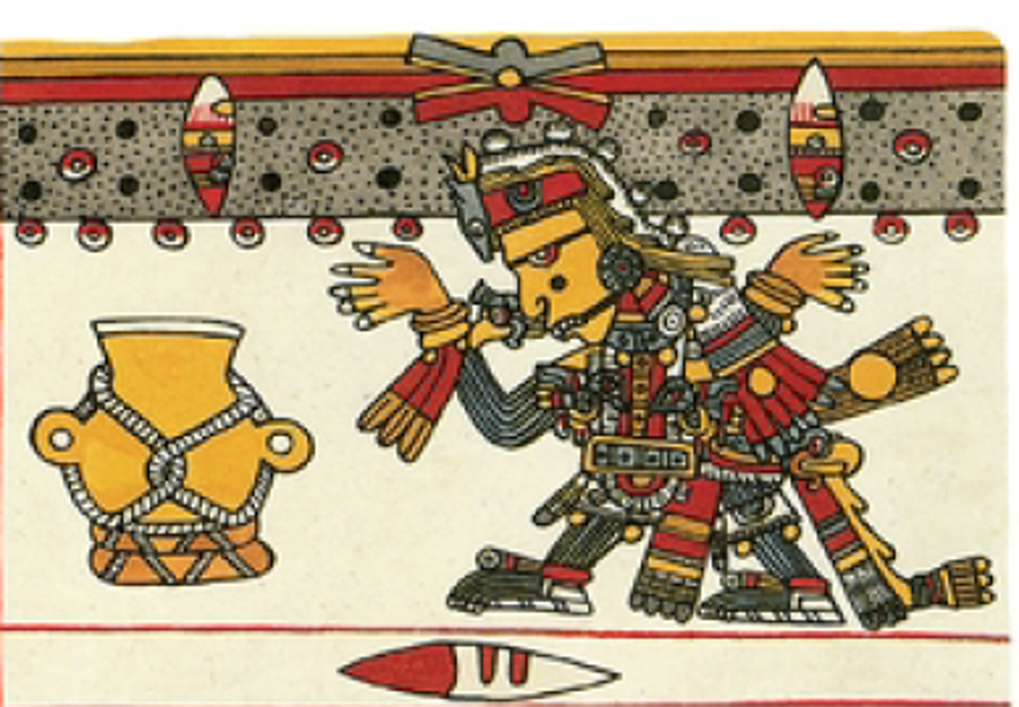
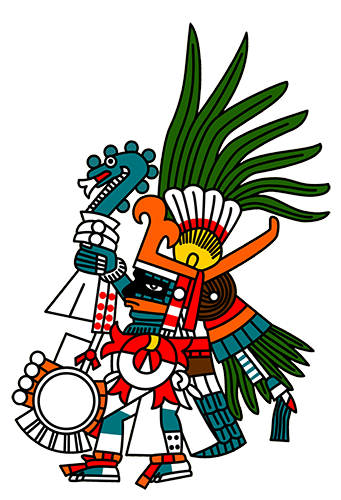
Códice Borgia — the Will Fed by the Morning Sun. Beneath a band of stars, the figure rises with both arms lifted, caught in the act of motion. This is Tetzahuitl — the astonishing — the force of willpower drawn up out of the night and nourished each dawn by Huitzilopochtli, the morning Sun. The will is not summoned frSom beyond the world; it is raised from within it, at the hour the light returns.
THIS BOOK IS WRITTEN IN SPANISH. WORKING ON ENGLISH TRANSLATION.
Huey Tlahtokan Notes
Mosaico de Turquesas is the foundational text of Mexica philosophical and scientific thought in the modern era. In twenty rigorously researched chapters, Maestro Arturo Meza Gutiérrez dismantles five centuries of colonial mistranslation and reveals the authentic cosmological framework of the ancient Mexica — not as mythology or religion, but as a complete and sophisticated science of existence. At its core is Ometeotl, the dual generating principle, and the Nahui Tezcatlipoca — the four cosmic functions that ancient Mesoamerican civilization studied, encoded, and applied across every field of human knowledge, from psychology and medicine to astronomy and mathematics.
The chapters move through this system piece by piece: the dual expression of Huehuetlahtolli (the ancient word), Tlaltecuhtli and Tlalcihuatl as Father-Mother Earth, the transmuting nature of duality itself, Mictlan and Moyocoyani as expressions of Ometeotl, Tloquenahuaque as the ordering of time and space, and the feminine essence carried through Xochiquetzalli, Chantico, and Mayahuel — closing on the mosaic of turquoise itself as the ancestral thread binding the whole system together. Written as a direct companion to Meza's earlier Cauhpohualli, the two works together form the fuller architecture underlying everything he wrote afterward, including Mosaico de Jade.
This is not an introductory text — it rewards the serious reader who is ready to encounter one of the most profound knowledge systems ever developed by human civilization, presented in its own language, its own logic, and its own scientific precision. Required reading for anyone seeking to understand the true intellectual heritage of Indigenous Mexico beyond the distortions of conquest.
From the Publisher
Mosaico de Turquesas reveals the essence of Nature and of the Human Being from the perspective of the native Philosophy of Duality. From this, Ometeotl is recognized as the Supreme Principle, masculine and feminine, the Father and Mother of all that exists, giving rise to the Laws of the Universe and the Laws of Life of the Prehispanic Peoples. From Ometeotl unfold the four Tezcatlipocas: the Dark, the Red, the Blue called Huitzilopochtli, and the White called Quetzalcoatl.
272 páginas.
Descripción (Español):
Notas de Huey Tlahtokan (Heading 4)
Mosaico de Turquesas es el texto fundacional del pensamiento filosófico y científico mexica en la era moderna. En veinte capítulos rigurosamente investigados, el Maestro Arturo Meza Gutiérrez desmonta cinco siglos de mala traducción colonial y revela el auténtico marco cosmológico de los antiguos mexicas — no como mitología ni religión, sino como una ciencia completa y sofisticada de la existencia. En su núcleo está Ometeotl, el principio dual generador, y el Nahui Tezcatlipoca — las cuatro funciones cósmicas que la antigua civilización mesoamericana estudió, codificó y aplicó a través de todos los campos del conocimiento humano, desde la psicología y la medicina hasta la astronomía y las matemáticas.
Los capítulos recorren este sistema pieza por pieza: la expresión dual del Huehuetlahtolli (la palabra antigua), Tlaltecuhtli y Tlalcihuatl como Padre-Madre Tierra, la naturaleza transmutadora de la dualidad misma, Mictlan y Moyocoyani como expresiones de Ometeotl, Tloquenahuaque como el ordenamiento del tiempo y el espacio, y la esencia femenina presente en Xochiquetzalli, Chantico y Mayahuel — cerrando con el mosaico de turquesas mismo como el hilo ancestral que une todo el sistema. Escrito como complemento directo del Cauhpohualli anterior de Meza, ambas obras forman en conjunto la arquitectura más completa que sustenta todo lo que escribió después, incluyendo Mosaico de Jade.
Este no es un texto introductorio — recompensa al lector serio que está listo para encontrarse con uno de los sistemas de conocimiento más profundos jamás desarrollados por la civilización humana, presentado en su propio idioma, su propia lógica y su propia precisión científica. Lectura obligada para quien busca comprender la verdadera herencia intelectual del México indígena más allá de las distorsiones de la conquista.
De la Editorial
La obra Mosaico de Turquesas revela la esencia de la Naturaleza y del Ser Humano desde el punto de vista de la Filosofía autóctona de la Dualidad. De ello, se reconoce que Ometeotl es el Principio Supremo masculino y femenino, es el Padre y la Madre de todo lo existente, dando origen a las Leyes del Universo y a las Leyes de la Vida de los Pueblos Prehispánicos. De Ometeotl se desdoblan los cuatro Tezcatlipoca: el Obscuro, el Rojo, el Azul llamado Huitzilopochtli y el Blanco llamado Quetzalcoatl.
THE BLUE TEZCATLIPOCA
MATHEMATICS
Cosmically, absolutely nothing in the universe stands still. Every particle, every season, every heartbeat moves by Ollin — and the law beneath all of it is number itself. Mathematics is not counting — it is the law of all movement. From the turning of the stars to a single human decision, everything that moves is governed by measure, proportion — every Body in the universe, cosmic & human, moves via Ollin.
The Morning Sun rises by its own cosmic Willpower. So does the one who carries the grade of Huitzilopochtli — the rare human who can take a whole people from stillness into purposeful movement. Willpower is not a feeling — it is mathematics applied to the human spirit. For 260 years the Mexihca held one direction across a hundred lifetimes, and built a city at the end of it.
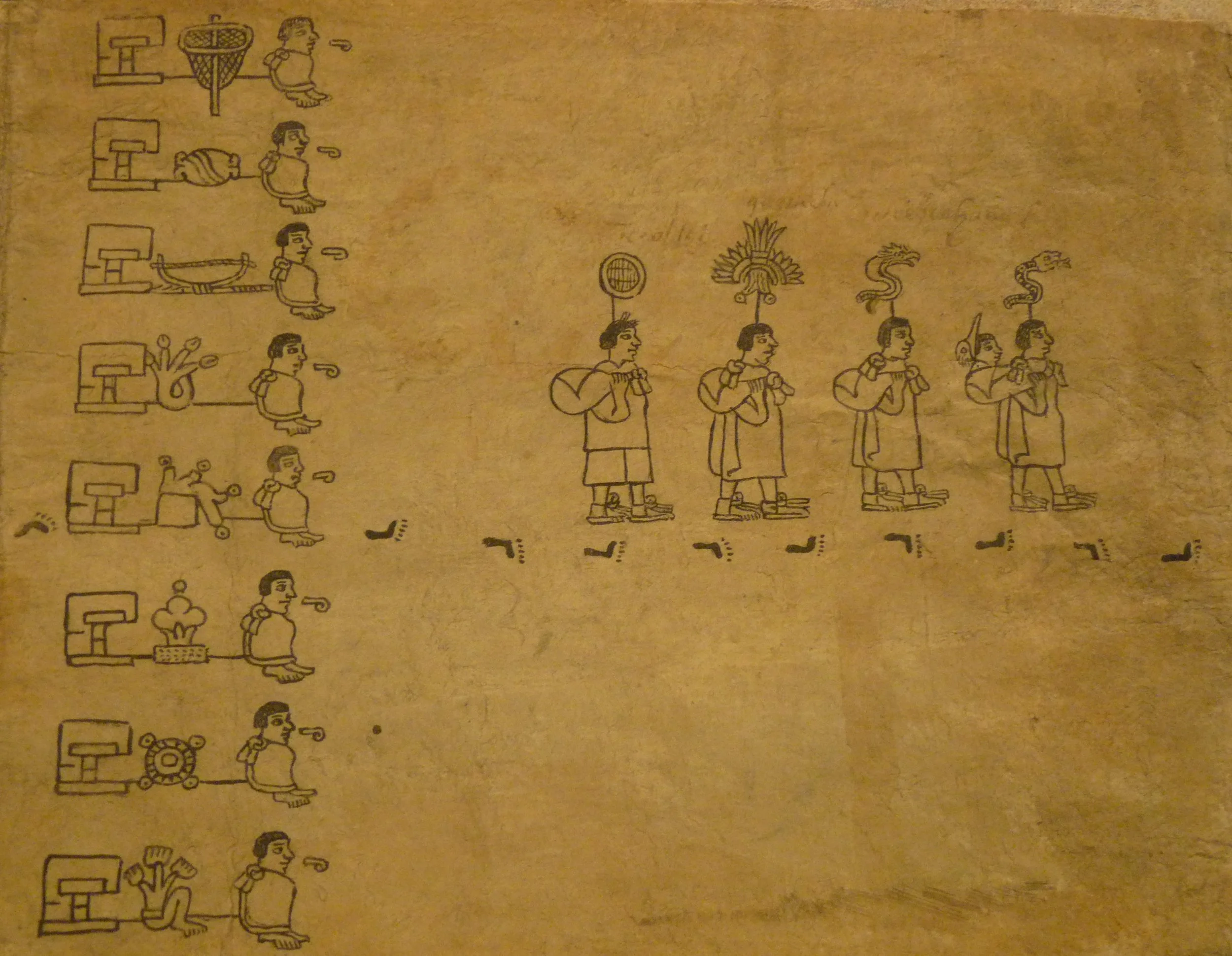
Huitzilopochtli in motion — Códice Boturini, La Salida de Aztlan. Not a god being carried, but a grade: The Teomamaque bear the will of a people migrating out of Aztlan. This is what Huitzilopochtli actually looks like — the force of Willpower held in human hands as they set out walking.
These were not gods descending from the sky. They were human beings who became Huitzilopochtlis — and guided a people for 260 years. It is the metaphor of the carried will of a people leaving, by prophecy, to find a better life that ended in the founding of Mexihco-Tenochtitlan.
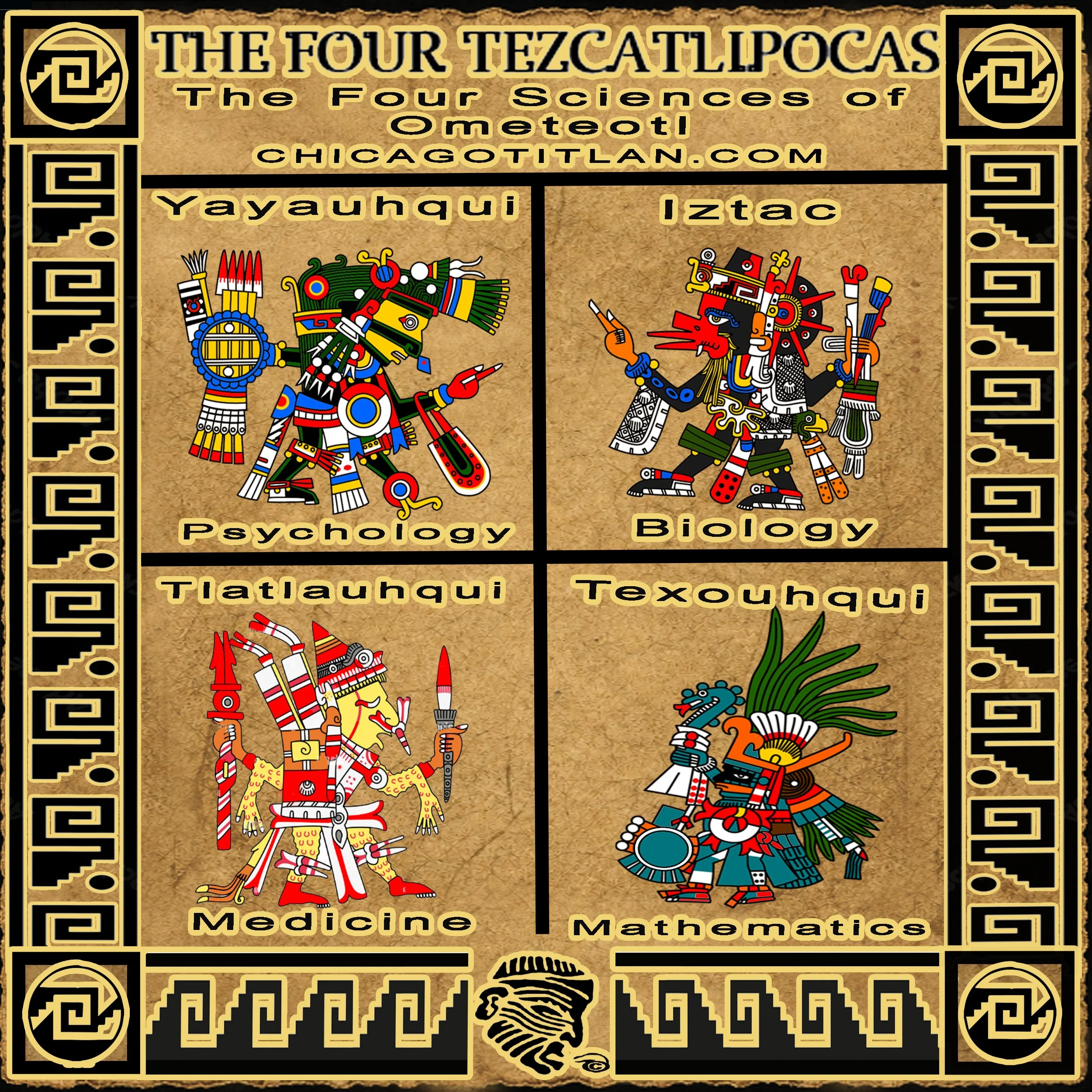
Biology, Psychology, Medicine, and Mathematics — the four sciences the Mexihca encoded into every direction of life, expanded far beyond what any single page can hold.
This booklet is the full research behind the Four Tezcatlipocas: Iztac (Biology), Yayauhqui (Psychology), Tlatlauhqui (Medicine), and Texouhqui (Mathematics). Drawing on the scholarship of Maestro Meza Gutiérrez and cross-referenced against the codices — Borgia, Borbónico, Vaticano B, Cospi — this is the source material, not a summary of it.
Inside, each Symbol gets its own deep breakdown: its color, its direction, its function, and the science behind it — from the biology of Quetzalcoatl to the astronomy of Mixcoatl to the birth of dentistry under Tlatlauhqui. No mistranslations, no "gods" — this is the scientific framework as the Mexihca built it, restored.
Delivered instantly as a PDF download. 38 pages. ENGLISH VERSION. Download and save your file right away. Your link expires 24 hours after your first download.
By Alberto A. Cuauhtlequezqui Lopez, Huey Tlahtokan · La Gran Palabra · ChicagoAztlan © 2004–2026
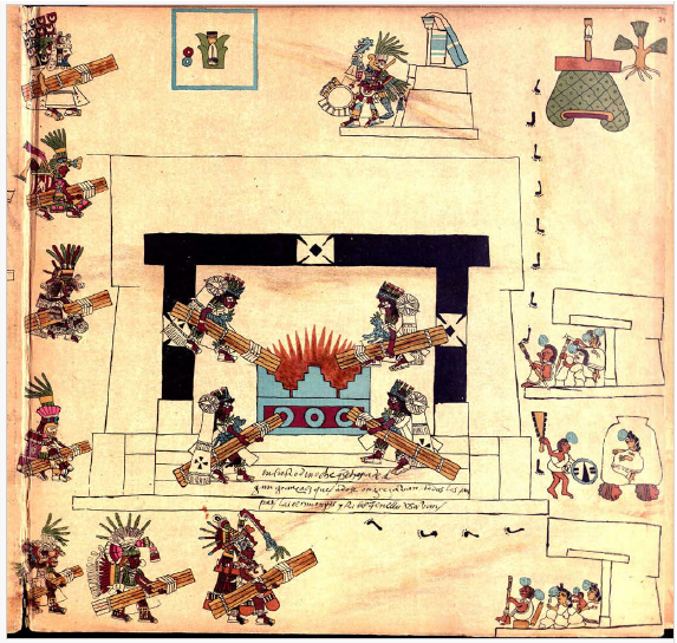
Fire renewed — Códice Borbónico, the New Fire Ceremony. Every fifty-two years the calendar round closes and the people gather for Xiuhmolpilli — the Binding of the Years. Across the scene, processions carry bundles of cane and wood toward the center, where the New Fire is kindled. This is the Blue science working on its largest scale: not the motion of a single body, nor the march of a people, but the turning of time itself.
-
Nothing in the universe stands still. Texouhqui is the science of everything that moves.
Texouhqui is the Blue Tezcatlipoca — the fourth function of Ometeotl, the science of movement, measure, and number. The name itself rests on evidence, not preference: we accept Texouhqui because in the Codex Borgia and the Codex Vaticano B this Tezcatlipoca carries this blue color, and in both of those codices — and again in the Codex Cospi — he is accompanied by the glyph Ollin, movement itself. In the Codex Borbónico he is displayed in his full magnificence, painted in that same blue (Lám. 32). And in the Codex Borgia he appears holding up the sky — bearing the heavens on his own strength — with the Nahui Ollin, the Four-Movement, set above his head, and in his hands the Xiuhcoatl — also called the Xoniquilli — to which the Pleiades are attached: the Blue Tezcatlipoca carrying the firmament, crowned by the very glyph of cosmic motion. Across these codices the same association recurs — blue, and movement. That convergence is how a principle is confirmed.
In the moment of the formation of all that was created, it is the Tezcatlipoca Huitzilopochtli who maintains the constant activity in everything that exists. Nothing in the cosmos is ever truly at rest — every particle, every orbit, every season is in motion, and that motion is held and sustained by this Blue function. What Yayauhqui holds as memory and Tlatlauhqui orders into form, Texouhqui keeps in perpetual movement.
At the level of the human being, this same function turns around constant action — physical and creative alike. The will to move, the agility to act, the decision that sets a body or a people into motion: these are not separate from the cosmic principle. They are the same force operating at the human scale. This is not a metaphor. The law that moves the stars is the law that moves a human choice.
When the science is classified into its several functions — Tetzahuitl, Painal, Huitzilopochtli — we begin to see why the Blue Tezcatlipoca was so special to the Mexihca-Tenochca people. They were a people defined by movement: a nation that walked for centuries before it stood still. The science of measured, willed motion was not abstract to them. It was the discipline that built a city. This is the science of mathematics, movement, and human potential — for everything that moves, moves by measure, and the law beneath all of it is Ollin.
The Huitzilopochtlis — The Actual People
Huitzilopochtli is a grade, and the people who attained it were called Huitzilopochtlis. They were real, named human beings — the guides who led the Mexihca-Tenochca families across the 260-year migration from Aztlan to the founding of Mexihco-Tenochtitlan:
Tenoch · Cuauhcoatl · Apanecatl · Chimalma · Ocelopan · Cuauhtlequezqui — and many others. No single one of them guided the people for 260 years. The grade was carried by a succession of Huitzilopochtlis, each holding the people's direction across his own lifetime and passing it on to the next. Tenoch, the most documented, gave his name to Tenochtitlan itself.
The grade is registered as a proper name since Toltec times — older than the Mexihca, inherited and carried forward, not invented.
These were not gods descending from the sky. They were human beings who became Huitzilopochtlis — and guided a people for 260 years.
What the Teomamaque Carried
In the Salida de Aztlan the teomamaque are shown carrying a bulto — a wrapped bundle — from which the head of a hummingbird emerges. What the bundle literally held is open to interpretation, and has been argued over for centuries. But in the Blue science the meaning is clear: the hummingbird is Huitzilopochtli, and what the guides truly carried out of Aztlan was not an object but a force — the concentrated willpower of an entire people, and the prophecy that drove them to find a better land.
The bulto is the will made portable. The teomamaque did not carry a god on their backs; they carried the decision of a people to keep moving — generation after generation, for 260 years — until the prophecy was fulfilled on the islet where they founded Tenochtitlan.
What they carried was not a god in a bag. It was the willpower of a people — and a prophecy: the decision to migrate toward a better life.
-
Huitzilopochtli was never a god of war. He is a grade — the highest development of the human will.
In the sixteenth century, and still today, Huitzilopochtli has been confused with a god of war — read in the manner of Greek mythology, as a bloodthirsty deity demanding hearts. The misreading is double. First, there is no "god" here at all: in the framework of Teotl — the generating essence — no indigenous language carries a word for a deity in the Judeo-Christian or Greco-Roman sense. Second, there is no "war." What the colonizers were looking at was a science they had no category for, so they reached for the only category they knew — Mars, Ares, a war-god — and forced an entire body of knowledge into it.
What they were actually looking at was the science of the human will. Huitzilopochtli is a grade — a level of knowledge and capacity that a person could study toward and attain, the way one might earn a degree. As an astronomical concept it names the morning Sun and its yearly path; in the human being it names the developed power to decide, to direct energy, and to move oneself and others. Neither meaning has anything to do with bloodshed.
The chronicles even preserved a song to it — the Huitzilopochtli icuicac recorded in Book III of Sahagún — whose opening lines picture the young one rising and walking the path, lit by the radiance of the dawning Sun. The imagery is solar and ascending, not martial. The "warrior" the colonizers saw was their own projection laid over a science of self-mastery.
To call Huitzilopochtli a war god is to mistake the discipline of the will for an appetite for blood. Recovering the real meaning does not soften the figure — it restores it. What was buried under five centuries of mistranslation is not a religion but a method: leadership, willpower, and decision, taught and graded like any other science.
-
Wonder is not a passive feeling. It is the spark that moves a human being to act.
The first of Texouhqui's functions is Tetzahuitl — literally "the astonishing" or "the portentous." It is the capacity we carry to perceive what fills us with admiration, and through that admiration to be moved into action by the power of decision. Wonder, here, is not where thought stops; it is where movement begins.
What is portentous and admirable in the force of the will is that it can actually be realized — and there is nothing supernatural in it. This is the heart of the matter, and it is easy to miss. The wonder of Tetzahuitl is precisely that it never exceeds the natural order. If it did — if Tetzahuitl named some power beyond nature — we would be forced to admit that something foreign to our own world exists within our space. It does not. The force of the will, though it is driven from the inner being, is entirely real and entirely natural. The astonishing thing is not that it comes from elsewhere; the astonishing thing is to bring it to the very surface, to the skin. For our ancestors, holding the will at that pitch was not a miracle. It was a normal, trainable human capacity.
Tetzahuitl works as two forces at once. From within, it is the inner being's own impulse — the admiration that ignites the resolve to act. From without, it is fed by Huitzilopochtli, the morning Sun, who appears each dawn with his radiance on the horizon, nourishing the willpower of every living being. The capacity recorded in the Codex Borgia is therefore both ours and the Sun's: an inner spark answered each morning by an outer one.
In the Blue science, Tetzahuitl is the first motion — the instant perception turns into the decision to move. Before agility, before leadership, before a people can be set walking for centuries, there must be this: something seen that is worth moving toward.
-
In the Blue science, everything is movement — and Painal is the one who has mastered it in the body.
Painal is "the light-footed one," "the one who is swift to move." In the Blue Tezcatlipoca, everything is related to movement and activity, so it is fitting that one of its grades is the discipline of speed itself. The Painal Huitzilopochtli is the young one who demonstrates the qualities of agility, dexterity, and velocity in running — but never speed alone.
What makes Painal a science rather than a footrace is that physical swiftness is joined to an activated mental agility: the quickness of mind that lets the runner read the ground in real time and clear the obstacles that appear in his path. A fast body that cannot think stumbles. The Painal trains both at once — the legs and the judgment — until they act as a single reflex. This is movement made intelligent.
Painani means "the one who is swift." It names the achievement; Painal names the grade. And the grade is a step on a ladder: the one who attains the title of Painal can go on to become a true Huitzilopochtli. Mastery of one's own movement is the apprenticeship for the mastery of a people's movement. Before a person can lead a nation across a continent, he must first prove he can govern the motion of his own body and mind under pressure.
This is the discipline that will later be tested in the great solstice race, the Ipayna Huitzilopochtli — the marathon in which the chosen youth carries the fragile figure without breaking it. Painal is the science behind that test: speed of body and speed of mind, fused into one trained will.
-
The Morning Sun rises by its own will. So does the one who carries this grade.
The name is composed of huitzilli — hummingbird — and opochtli — left. Literally, it is "the Hummingbird of the Left Side." As an astronomical concept, Huitzilopochtli is "the southern hummingbird" or "the left hummingbird," and the meaning is precise: it refers to the morning Sun that rises more often from its left side than its right. Across the year the point of sunrise swings — beginning its morning displacement at the winter solstice and traveling toward the summer solstice, rising in these latitudes fewer times from its right. The left side is the south, Huitztlanpa, the place of thorns. The name is a record of the Sun's annual path, written in the language of direction.
In the human being, this same force activates and animates people with the strength and energy to live the daily struggle. The Sun that climbs the sky by its own ascending power is the same principle that climbs in a person as resolve. That is why the grade carries the Sun's name.
This grade of knowledge is no late invention. It is registered as a proper name since Toltec times — which disproves those who claim it was created by the Mexihca. The science was inherited, carried forward from an older Mesoamerica, and refined. It is the highest grade of the Blue science: the fully developed human will, the one who can take a whole people from stillness into purposeful movement.
The one who holds it can do something rare — gather people, place them in ceremony, and concentrate their will toward a single goal. This is the science of collective Ollin: many separate wills aligned into one movement. Directed in ceremony, that concentrated energy could be turned toward a shared end — to call the rain, to ready a nation for a long journey, to hold a people together across generations. It is leadership understood not as command, but as the mathematics of aligned will.
Huitzilopochtli is not a god who demands blood. He is the grade of the human being who can move a people.
-
For 260 years a people walked toward a city none of them would live to see finished. That is the Blue science of Tezcatlipoca made flesh.
This was the grade held by the great guides of the Mexihca-Tenochca families — those who, across more than two centuries of migration, led their people from the northwest to the high plateau of Mexico. The dates give it precisely: a departure from Aztlan in 1065 and the founding of Mexihco-Tenochtitlan in 1325 — exactly 260 years. That number is not incidental. Two hundred sixty is the count of the tonalpohualli, the sacred count of destinies. The migration was a full sacred cycle carried up out of days and into years: a calendar walked across the land.
History preserves their names: Tenoch, Cuauhcoatl, Apanecatl, Chimalma, Ocelopan, and Cuauhtlequezqui — and many others. They were the teomamaque, the ones entrusted to carry the people's direction, and their lineage was preserved by their descendants long after the families had settled on the islet where they founded the city. The grade did not die with any one of them. No single lifetime spans two and a half centuries, so the grade was carried, lost, and recovered across generations — passed to whoever in each generation could hold the people's will steady and keep them moving.
They were not generals, and the migration was not a war. They were holders of collective will — the ones who kept a wandering nation in coherent motion toward a place none of them would live to see completed. Each guide moved a people he would have to hand off; each trusted that the direction would be carried by someone not yet born.
This is what the grade of Huitzilopochtli meant in practice: the human science of keeping a people in purposeful motion, not for a season or a campaign, but on the scale of centuries. It is the longest proof in Mesoamerican history that willpower is a real, measurable, transmissible force — the Blue Tezcatlipoca science sustained across 260 years until it raised a city out of a lake.
-
The Sun dies at sunset and is reborn at dawn by its own will. Panquetzaliztli is the night the people stay awake to witness it.
Panquetzaliztli — "The Raising of the Banners" — is the fifteenth veintena, the fifteenth twenty-day month. Its name has no variants. This is the month in which the Mexihca celebrated the birth of Huitzilopochtli at the Winter Solstice, and the companion of the veintena is the hummingbird of his left side.
For the human being, Panquetzaliztli is the school of the rising Sun: tenacity and willpower joined to the capacity for decision — the power to resolve any situation, however difficult it appears. Those chosen to embody this concept of will and decision were prepared four months in advance. Their qualities had to be the qualities of the warrior — courage, decision, and great physical preparation — and the chosen one had to prove himself the lightest and the swiftest of all.
Four days before the feast, the figure of Huitzilopochtli was formed from tzoalli — amaranth dough — kneaded with honey. The young men worthy of proving their lightness fasted almost completely through those four days, taking only a little tzoalli with honey and water at midnight. Their bodies were purified in the spring called Huitzilatl, in Huitzilopochco, south of Tenochtitlan. After the four days, a general fast was kept by the whole people, who gathered to sing and dance before the great ceremony. The dances ended at midnight; the people returned home, and as the sky began to lighten, the great festival began — before the Sun rose.
The reason for the month, and for the hour, is written in the sky. At the Winter Solstice the Sun reaches its furthest displacement to its left, toward Huitztlanpa, "the place of thorns" — the name given to the south. Having lost strength day by day, the Sun dies as it reaches this point at sunset; its death is sudden, and so it was symbolized. The instant it lifts above the horizon at the next dawn is understood as the birth of the young Sun. Its warmth is the new energy of the young hummingbird the Tenochca awaited each year — the force to undertake new ventures. The whole people received this new vigor with the deepest respect and with confidence in themselves and in everything around them. This force of the rising Sun is precisely what was conceived as Huitzilopochtli.
The chosen youth, receiving the image of Huitzilopochtli, had to prove the vigor he had absorbed. He set out at once on a great race — like a marathon — in which he had to keep hold of the fragile figure without letting it break. This race was called Ipayna Huitzilopochtli. In the ceremonial precinct the students of the Telpochcalli also staged mock battles, armed with branches of oyametl — fir — and reeds bound four by four; those who lost had ground maguey pulp placed on their backs, which stung fiercely. Every ceremony was carried on the rhythm of the percussion — the huehuetl, the panhuehuetl, and the teponaztli.
In this same month the people gave thanks to the trees and plants for the fruit, the coolness, the shelter, the wood, and the firewood they had given, adorning them with banners and bands of colored paper.
Every fifty-two years this veintena carried a special weight. As the star cluster Mamalhuaztli — the fire-drill, known today as the Belt of Orion — reached the zenith over Tenochtitlan at the midnight of the winter solstice, the New Fire was kindled in the Ome Acatl year. The Blue science of movement and will turned, on that one midnight, on the scale of half a century.
The people stayed awake through the death of the old Sun and raised their banners as the new one was born. That is willpower made into a calendar.
This is why Panquetzaliztli closes the Blue science. Everything Texouhqui teaches — Ollin, the wonder of Tetzahuitl, the swiftness of Painal, the leadership of Huitzilopochtli — is lived, once a year, in a single night.
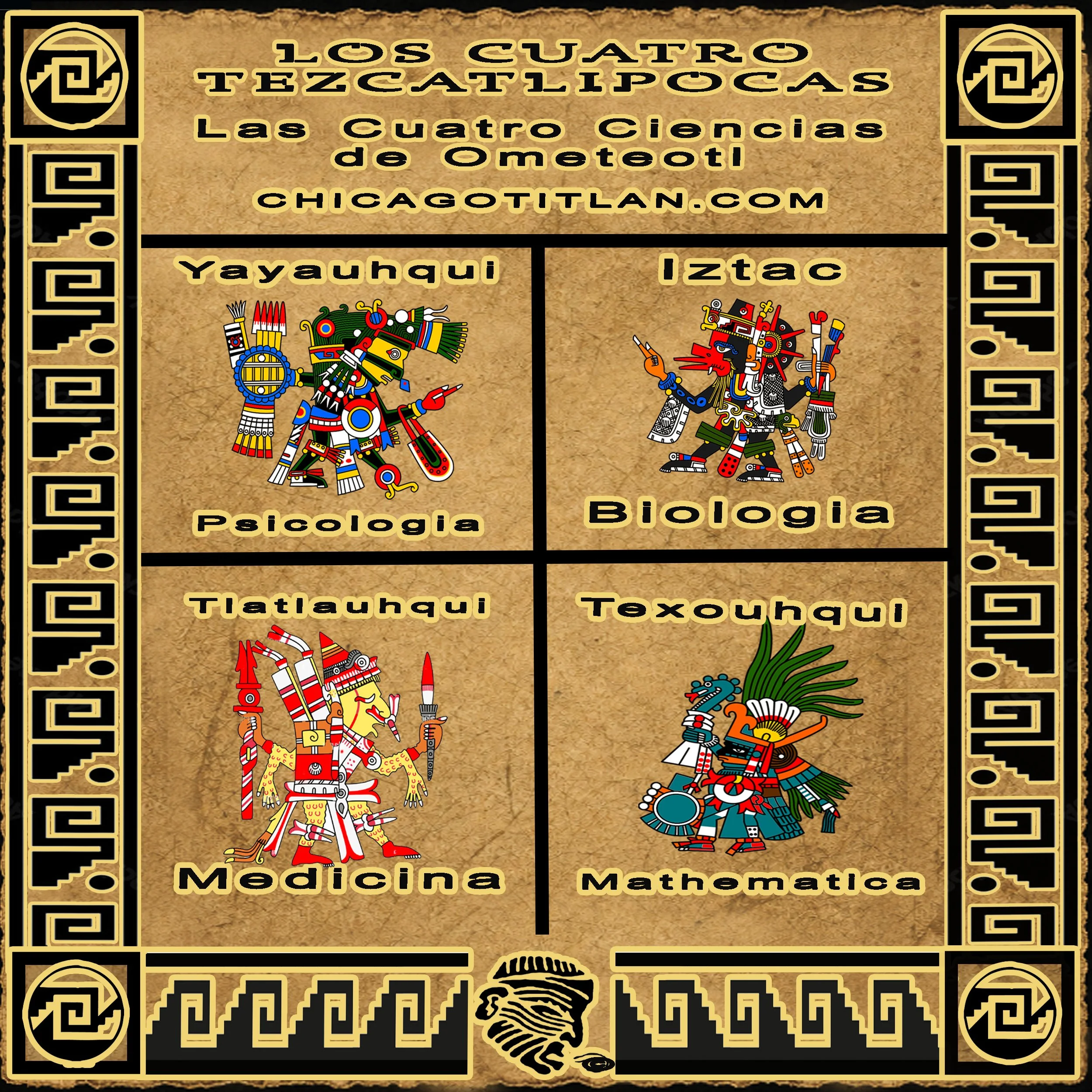
Biología, Psicología, Medicina y Matemáticas — las cuatro ciencias que los Mexihcas codificaron en cada dirección de la vida, ampliadas mucho más allá de lo que cabe en una sola página.
Este folleto es la investigación completa detrás de los Cuatro Tezcatlipocas: Iztac (Biología), Yayauhqui (Psicología), Tlatlauhqui (Medicina) y Texouhqui (Matemáticas). Basado en la erudición del Maestro Meza Gutiérrez y contrastado con los códices — Borgia, Borbónico, Vaticano B, Cospi — este es el material fuente, no un resumen del mismo.
Adentro, cada Símbolo tiene su propio desglose profundo: su color, su dirección, su función y la ciencia detrás de él — desde la biología de Quetzalcoatl hasta la astronomía de Mixcoatl y el nacimiento de la odontología bajo Tlatlauhqui. Sin traducciones erróneas, sin "dioses" — este es el marco científico tal como lo construyeron los Mexihcas, restaurado.
Entrega instantánea como descarga en PDF. 38 páginas. VERSIÓN EN ESPAÑOL.
Descarga y guarda tu archivo de inmediato. Tu enlace vence 24 horas después de la primera descarga.
Por Alberto A. Cuauhtlequezqui Lopez, Huey Tlahtokan · La Gran Palabra · ChicagoAztlan © 2004–2026
THIS BOOK IS IN SPANISH, ENGLISH PLANNED SOON.
Description (English): Huey Tlahtokan Notes
For five centuries, Quetzalcoatl and Tezcatlipoca have been read through the translations and assumptions of the first Spanish chroniclers — readings Arturo Meza Gutiérrez argues were never built on solid analytical footing. Over 352 pages, he works piece by piece, like inlaid jade and obsidian, toward a different account: one that doesn't discard the word passed down, generation to generation, in the quieter channels of oral memory.
The book doesn't stop at redefining its two central figures. Meza extends the same rigor to the wider conceptual world of the ancient Nahua — Ometeotl, Moyocoyani, Cipactonal, Xipe Totec, Mixcoatl, Xochiquetzalli, Centeotl, Xochipilli, and more — building a fuller picture of a philosophical system too often flattened into mythology.
Arturo Meza Gutiérrez has spent decades researching Mesoamerican philosophy outside official/colonial narratives. Other titles: Cauhpohualli (1984/1999/2018), Tezcatlipoca: Nuestro ser interno (1997), Mosaico de turquesas (2005), Las Flores en el Espejo (2017).
From the Publisher
About Tezcatlipoca and Quetzalcoatl, a series of doubts without apparent solution have arisen, resulting in claims that lack solid analytical grounding drawn from name translations and the interpretations of the first chroniclers. In this collection of testimonies, the author has gathered, piece by piece, in a mosaic of jade and obsidian, a new proposal — one that does not exclude the word whispered generation after generation for more than 500 years, with the vigorous and vibrant echo that reaches us as inheritance, toward achieving excellence as human beings and as Mexicans.
From a new analysis of ancient indigenous Mexican philosophy, the author opens his focus on the concept of dual nature manifested in Tezcatlipoca and Quetzalcoatl, with the aim of deepening awareness of the great value they represent.
352 páginas.
Descripción (Español): Notas de Huey Tlahtokan
Durante cinco siglos, Quetzalcoatl y Tezcatlipoca han sido leídos a través de las traducciones y apreciaciones de los primeros cronistas españoles — lecturas que, según Arturo Meza Gutiérrez, nunca tuvieron un sólido sustento analítico. A lo largo de 352 páginas, el autor reúne, pieza por pieza, como un mosaico de jade y obsidiana, una nueva propuesta: una que no excluye la palabra susurrada al oído, generación tras generación, por la vía más silenciosa de la memoria oral.
El libro no se detiene en redefinir a sus dos figuras centrales. Meza extiende el mismo rigor al resto del mundo conceptual de los antiguos nahuas — Ometeotl, Moyocoyani, Cipactonal, Xipe Totec, Mixcoatl, Xochiquetzalli, Centeotl, Xochipilli, entre otros — construyendo un panorama más completo de un sistema filosófico que con frecuencia se reduce a mitología.
Arturo Meza Gutiérrez lleva décadas investigando la filosofía mesoamericana fuera de las narrativas oficialistas. Entre sus otros títulos: Cauhpohualli (1984/1999/2018), Tezcatlipoca: Nuestro ser interno (1997), Mosaico de turquesas (2005), y Las Flores en el Espejo: Xochiquetzalli y la esencia femenina (2017).
De la Editorial
Sobre Tezcatlipoca y Quetzalcoatl se ha generado una serie de dudas sin solución aparente, resultando aseveraciones que no tienen un sólido sustento analítico a partir de la traducción de los nombres y de las apreciaciones de los primeros cronistas. En esta recopilación de testimonios, el autor ha reunido pieza por pieza en un mosaico de jade y obsidiana, una nueva propuesta, en la que no excluye la palabra que se ha susurrado al oído generación tras generación en más de 500 años, con el eco vigoroso y vibrante que nos llega como herencia, para lograr la excelencia como seres humanos y como mexicanos.
A partir de un nuevo análisis de la antigua filosofía indígena de México, el autor abre su percepción enfocada al concepto de naturaleza dual manifestado en Tezcatlipoca y Quetzalcoatl, con el objetivo de profundizar la conciencia acerca del gran valor que representan.
THIS BOOK IS WRITTEN IN SPANISH. WORKING ON ENGLISH TRANSLATION.
Huey Tlahtokan Notes
Mosaico de Turquesas is the foundational text of Mexica philosophical and scientific thought in the modern era. In twenty rigorously researched chapters, Maestro Arturo Meza Gutiérrez dismantles five centuries of colonial mistranslation and reveals the authentic cosmological framework of the ancient Mexica — not as mythology or religion, but as a complete and sophisticated science of existence. At its core is Ometeotl, the dual generating principle, and the Nahui Tezcatlipoca — the four cosmic functions that ancient Mesoamerican civilization studied, encoded, and applied across every field of human knowledge, from psychology and medicine to astronomy and mathematics.
The chapters move through this system piece by piece: the dual expression of Huehuetlahtolli (the ancient word), Tlaltecuhtli and Tlalcihuatl as Father-Mother Earth, the transmuting nature of duality itself, Mictlan and Moyocoyani as expressions of Ometeotl, Tloquenahuaque as the ordering of time and space, and the feminine essence carried through Xochiquetzalli, Chantico, and Mayahuel — closing on the mosaic of turquoise itself as the ancestral thread binding the whole system together. Written as a direct companion to Meza's earlier Cauhpohualli, the two works together form the fuller architecture underlying everything he wrote afterward, including Mosaico de Jade.
This is not an introductory text — it rewards the serious reader who is ready to encounter one of the most profound knowledge systems ever developed by human civilization, presented in its own language, its own logic, and its own scientific precision. Required reading for anyone seeking to understand the true intellectual heritage of Indigenous Mexico beyond the distortions of conquest.
From the Publisher
Mosaico de Turquesas reveals the essence of Nature and of the Human Being from the perspective of the native Philosophy of Duality. From this, Ometeotl is recognized as the Supreme Principle, masculine and feminine, the Father and Mother of all that exists, giving rise to the Laws of the Universe and the Laws of Life of the Prehispanic Peoples. From Ometeotl unfold the four Tezcatlipocas: the Dark, the Red, the Blue called Huitzilopochtli, and the White called Quetzalcoatl.
272 páginas.
Descripción (Español):
Notas de Huey Tlahtokan (Heading 4)
Mosaico de Turquesas es el texto fundacional del pensamiento filosófico y científico mexica en la era moderna. En veinte capítulos rigurosamente investigados, el Maestro Arturo Meza Gutiérrez desmonta cinco siglos de mala traducción colonial y revela el auténtico marco cosmológico de los antiguos mexicas — no como mitología ni religión, sino como una ciencia completa y sofisticada de la existencia. En su núcleo está Ometeotl, el principio dual generador, y el Nahui Tezcatlipoca — las cuatro funciones cósmicas que la antigua civilización mesoamericana estudió, codificó y aplicó a través de todos los campos del conocimiento humano, desde la psicología y la medicina hasta la astronomía y las matemáticas.
Los capítulos recorren este sistema pieza por pieza: la expresión dual del Huehuetlahtolli (la palabra antigua), Tlaltecuhtli y Tlalcihuatl como Padre-Madre Tierra, la naturaleza transmutadora de la dualidad misma, Mictlan y Moyocoyani como expresiones de Ometeotl, Tloquenahuaque como el ordenamiento del tiempo y el espacio, y la esencia femenina presente en Xochiquetzalli, Chantico y Mayahuel — cerrando con el mosaico de turquesas mismo como el hilo ancestral que une todo el sistema. Escrito como complemento directo del Cauhpohualli anterior de Meza, ambas obras forman en conjunto la arquitectura más completa que sustenta todo lo que escribió después, incluyendo Mosaico de Jade.
Este no es un texto introductorio — recompensa al lector serio que está listo para encontrarse con uno de los sistemas de conocimiento más profundos jamás desarrollados por la civilización humana, presentado en su propio idioma, su propia lógica y su propia precisión científica. Lectura obligada para quien busca comprender la verdadera herencia intelectual del México indígena más allá de las distorsiones de la conquista.
De la Editorial
La obra Mosaico de Turquesas revela la esencia de la Naturaleza y del Ser Humano desde el punto de vista de la Filosofía autóctona de la Dualidad. De ello, se reconoce que Ometeotl es el Principio Supremo masculino y femenino, es el Padre y la Madre de todo lo existente, dando origen a las Leyes del Universo y a las Leyes de la Vida de los Pueblos Prehispánicos. De Ometeotl se desdoblan los cuatro Tezcatlipoca: el Obscuro, el Rojo, el Azul llamado Huitzilopochtli y el Blanco llamado Quetzalcoatl.