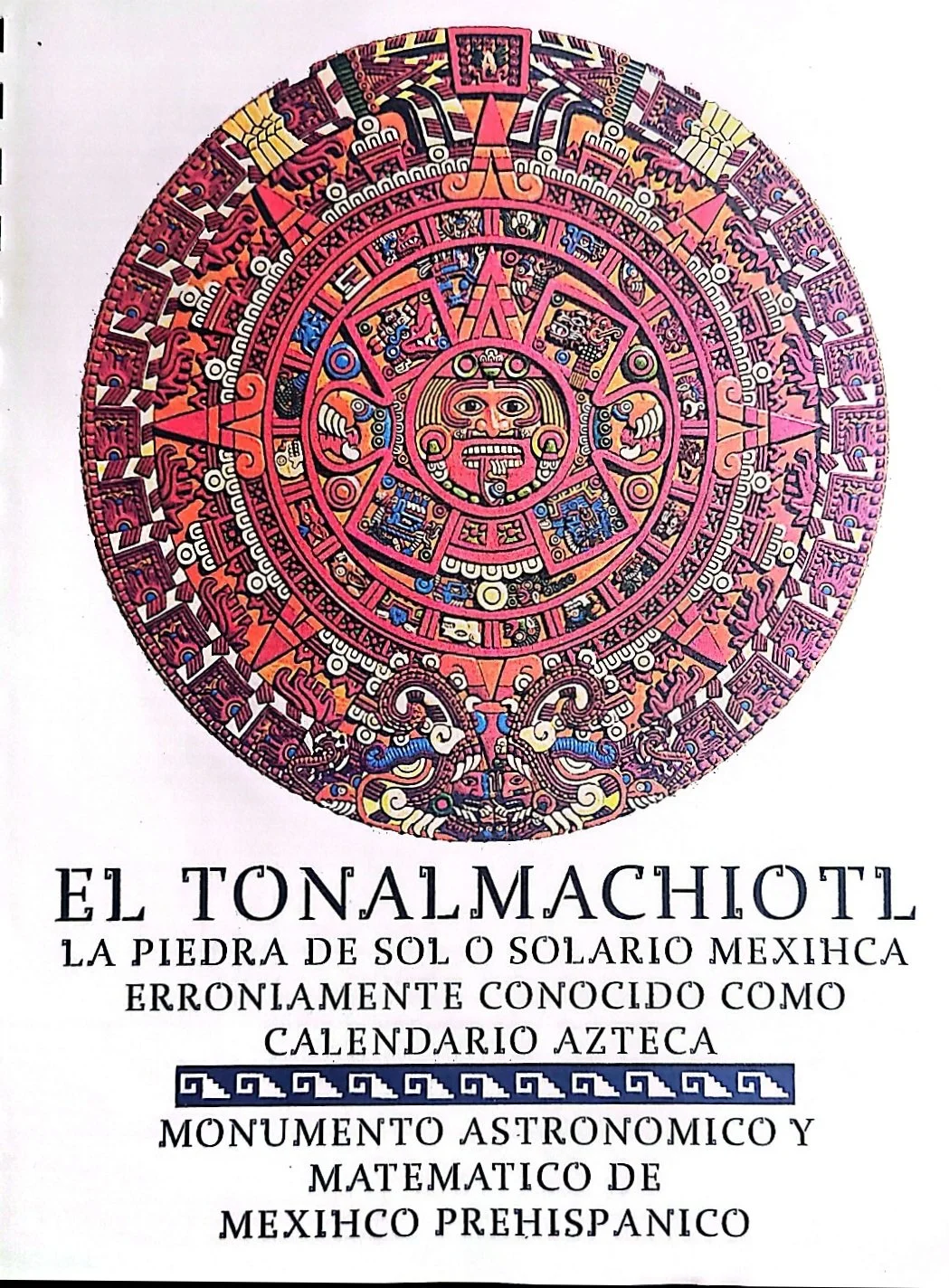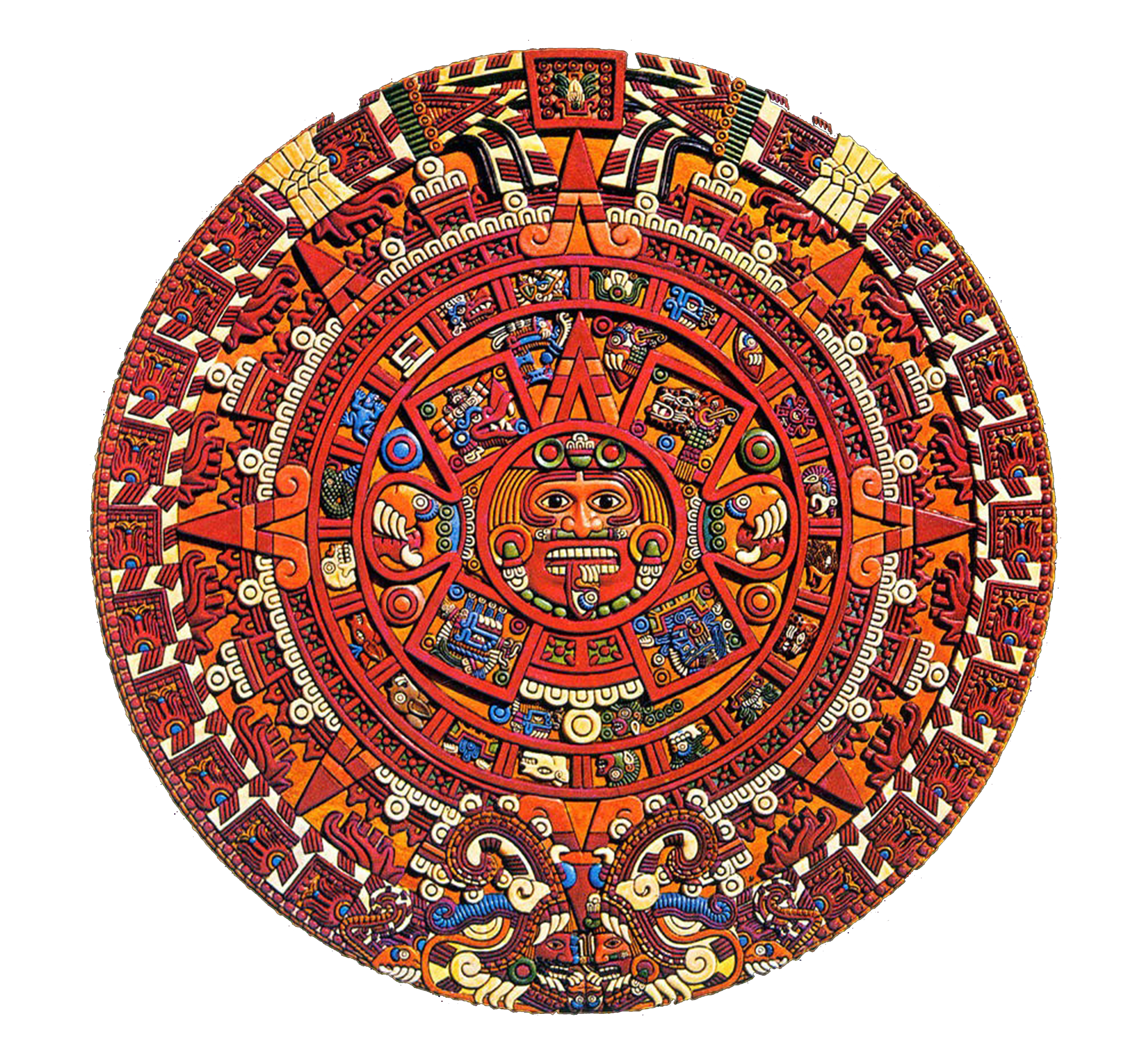
The monolith the world calls the "Aztec Calendar" is neither Aztec nor a calendar. Its true name is the Tonalmachiotl — the Sign of the Days, the Cosmographic Monument of the Soles — and it is the single most sophisticated astronomical computation device ever carved by human hands.
It was buried beneath the Plaza Mayor of Mexico City in 1521 and rediscovered on August 13, 1790 — the same date, 269 years later, that Tenochtitlan had fallen. The Cosmos did not forget.
Even the monument's raw dimensions carry a count. As transmitted by Maestro Ocelocoatl: its 3.65-meter diameter mirrors the 365 days of the Xiuhpohualli, the solar year. Its 24-ton weight mirrors the 24 hours of a single day. Before a single glyph on its face is read, the stone's own size and mass already speak in time.
For four centuries, colonial interpreters called its central face Tonatiuh, the Sun. They were not wrong, but there’s more to it. Per the research of Maestro Raúl Noriega — whose decipherments beginning in 1953 established the monument's true astronomical function — and confirmed by the oral tradition transmitted through the indigenous communities of Milpa Alta recorded in the Cuauhpohualli, the central face is Tlaltecuhtli, the masculine principle of the Earth. The Sun is present — but it is represented by an eagle, invisible to those who do not want to see it, fused with a butterfly in the Nahui Ollin at the moment of zenith passage over the heart of Tenochtitlan.
What the Tonalmachiotl actually encodes — confirmed through the decipherments of Noriega and the oral transmission of Maestro Ocelocoatl (Temachtiacatzin Ocelocoatzin) of the Mexihca tradition — is nothing less than the complete mathematical record of our solar system as observed from Earth:
IN
TONALMACHIOTL
-
EN: The monolith the world calls the "Aztec Calendar" is neither Aztec nor a calendar. Its true name is the Tonalmachiotl — the Sign of the Days, the Cosmographic Monument of the Soles — and it is the single most sophisticated astronomical computation device ever carved by human hands.
It was buried beneath the Plaza Mayor of Mexico City in 1521 and rediscovered on August 13, 1790 — the same date, 269 years later, that Tenochtitlan had fallen. The Cosmos did not forget.
This is not mythology. This is mathematics. This is astronomy. This is Toltecayotl — Excellence as Sacred Obligation — preserved in 1,878 signs carved into 24 tons of basalt.
Oral Tradition — Maestro Ocelocoatl: The dimensions themselves are the count. The Tonalmachiotl's 3.65-meter diameter mirrors the 365 days of the Xiuhpohualli, the solar year. Its 24-ton weight mirrors the 24 hours of a single day. Before a single glyph on its face is read, the stone's own size and mass already speak in time.
ES: El monolito que el mundo llama "Calendario Azteca" no es azteca ni es un calendario. Su nombre verdadero es el Tonalmachiotl — la Señal de los Días, el Monumento Cosmográfico de los Soles.
Fue enterrado bajo la Plaza Mayor de la Ciudad de México en 1521 y redescubierto el 13 de agosto de 1790 — la misma fecha, 269 años después, de la caída de Tenochtitlan. El Cosmos no olvidó.
Esto no es mito. Es matemática. Es Toltecayotl — la Excelencia como Obligación Sagrada — preservada en 1,878 signos tallados en 24 toneladas de basalto.
Tradición Oral — Maestro Ocelocoatl: Las dimensiones mismas son la cuenta. El diámetro de 3.65 metros del Tonalmachiotl refleja los 365 días del Xiuhpohualli. Su peso de 24 toneladas refleja las 24 horas de un solo día.
-
EN: For four centuries, colonial interpreters called the central face Tonatiuh, the Sun. They were wrong. Per the research of Maestro Raúl Noriega and confirmed by the oral tradition transmitted through the indigenous communities of Milpa Alta recorded in the Cuauhpohualli, the central face is Tlaltecuhtli, the masculine principle of the Earth.
ES: Durante cuatro siglos, los intérpretes coloniales llamaron al rostro central Tonatiuh, el Sol. Estaban equivocados. Según las investigaciones del Maestro Raúl Noriega y confirmado por la tradición oral de Milpa Alta registrada en el Cuauhpohualli, el rostro central es Tlaltecuhtli, el principio masculino de la Tierra.
Oral Tradition — Maestro Ocelocoatl: The face is the Earth. The eagle is the Sun. What appear to be the "claws" flanking the face are simultaneously the wing and tail of an eagle merged with the butterfly of the Nahui Ollin — Cuauhtli united with Ollin Papalotl — frozen at the precise moment of the second zenith passage of the Sun over the heart of Tenochtitlan. One moment. Carved forever in stone.
Tradición Oral — Maestro Ocelocoatl: El rostro es la Tierra. El águila es el Sol. Lo que parecen ser las "garras" son simultáneamente el ala y la cola de un águila fusionada con la mariposa del Nahui Ollin — Cuauhtli unido con Ollin Papalotl — congelado en el momento del segundo paso cenital del Sol sobre Tenochtitlan.
-
EN:
The Mascarón Solar encodes the synodic cycles of the visible planets as observed from Earth — Mercury, Venus, Mars, Jupiter, and Saturn — using a mathematical system built directly into the Deity's facial ornaments.
The nariguera (nose ornament) and orejeras (ear ornaments) are not decoration. Each is a multiplier mechanism. A base unit of 6.5 — half of the sacred number 13 — combines with paired glyph-multipliers carved as the Deity's eyebrows and eye sockets to generate a nested sequence of calendrical-astronomical cycles: 13, 52, 130, 260, 520, and 1,040 years. The nariguera alone yields the 130-year unit two separate ways; doubled, it produces 260 years, and doubled again, 520. Combined with the orejeras' matching sequence, the total reaches 1,040 years — ten centuries of 104 years, or twenty cycles of 52.
A separate ring of signs encodes an 80/320-year cycle: four periods of 80 years, sealed into the monument's fourth circle.
The precision is staggering. Noriega's decipherment produced a day-count for each planet's synodic revolution that matches modern astronomical calculation almost exactly:
PlanetModern average (days)Carved on the stoneMercury115.88117Venus583.92585Mars779.94780Jupiter398.88403Saturn378.09377
Mercury and Venus are carved one day over the modern average; Earth's revolution and Saturn's are carved one day under. This is not coincidence or approximation — it is a deliberate mathematical convention the astronomers of the Anahuac used to keep their long-count cycles in whole numbers.
ES:
El Mascarón Solar codifica los ciclos sinódicos de los planetas visibles desde la Tierra — Mercurio, Venus, Marte, Júpiter y Saturno — usando un sistema matemático construido directamente en los ornamentos faciales de la Deidad.
La nariguera y las orejeras no son decoración. Cada una es un mecanismo multiplicador. Una unidad base de 6.5 — la mitad del número sagrado 13 — se combina con multiplicadores pareados tallados como las cejas y las cuencas de los ojos de la Deidad, generando una secuencia anidada de ciclos calendárico-astronómicos: 13, 52, 130, 260, 520 y 1,040 años. La nariguera por sí sola produce la unidad de 130 años de dos formas distintas; duplicada, produce 260 años, y duplicada de nuevo, 520. Combinada con la secuencia equivalente de las orejeras, el total alcanza 1,040 años — diez siglos de 104 años, o veinte ciclos de 52.
Un anillo separado de signos codifica un ciclo de 80/320 años: cuatro períodos de 80 años, sellados en el cuarto círculo del monumento.
La precisión es asombrosa. El desciframiento de Noriega produjo una cuenta de días para la revolución sinódica de cada planeta que coincide casi exactamente con el cálculo astronómico moderno:
PlanetaPromedio moderno (días)Tallado en la piedraMercurio115.88117Venus583.92585Marte779.94780Júpiter398.88403Saturno378.09377
Mercurio y Venus están tallados un día por encima del promedio moderno; la revolución de la Tierra y la de Saturno, un día por debajo. Esto no es coincidencia ni aproximación — es una convención matemática deliberada que los astrónomos del Anáhuac usaron para mantener sus ciclos de cuenta larga en números enteros.
-
EN: The 8 Xiuhmitl (solar arrows) do double astronomical duty. Their positions mark the year's key solar events — the two equinoxes at the 3 o'clock position, the summer solstice at 2 o'clock, the winter solstice at 5 o'clock — while their total count of 8 simultaneously marks the 8-year cycle in which Venus completes exactly 5 synodic orbits of Earth.
The Macuilxochitl — the 5-Flower — is not mythology. It is an orbit. Over exactly 8 years, Venus traces 5 complete synodic cycles around Earth, and the path it draws in the sky is a perfect 5-petaled flower, visible to any naked-eye observer with patience.
Watch Venus and Earth draw the Macuilxochitl in real time → [link to GIF]
Oral Tradition — Maestro Ocelocoatl: The 8 Xiuhmitl mark the year and the heavens at once — the equinoxes at the 3 o'clock arrow, summer solstice at 2, winter solstice at 5 — and the count of 8 itself traces Venus completing 5 synodic cycles, the Macuilxochitl in the sky.
ES: Los 8 Xiuhmitl (flechas solares) cumplen doble función astronómica. Sus posiciones marcan los eventos solares clave del año — los dos equinoccios a las 3, el solsticio de verano a las 2, el solsticio de invierno a las 5 — mientras que su número total de 8 marca simultáneamente el ciclo de 8 años en que Venus completa 5 órbitas sinódicas alrededor de la Tierra.
El Macuilxochitl no es mitología. Es una órbita. Durante 8 años, Venus traza 5 ciclos sinódicos completos, dibujando una flor perfecta de 5 pétalos en el cielo.
Mira a Venus y la Tierra dibujar el Macuilxochitl en tiempo real → [link al GIF]
Tradición Oral — Maestro Ocelocoatl: Los 8 Xiuhmitl marcan el año y el cielo a la vez — los equinoccios en la flecha de las 3, el solsticio de verano a las 2, el solsticio de invierno a las 5 — y el número 8 mismo traza a Venus completando 5 ciclos sinódicos, el Macuilxochitl en el cielo.
-
EN: The Xiuhcoatl carries 11 squares on its body — encoding the ~11-year solar cycle: both the sunspot cycle, the rise and fall of visible magnetic activity on the Sun's surface, and the solar flares that intensify alongside it. Two faces of the same solar breathing pattern, one count.
Its earth form is the Mexican Mole Lizard — the segmented, clawed, blind earth-dweller whose ringed body mirrors the same mathematical structure. Four solar bars on the Xiuhcoatl's back encode the average 4-year cycle of El Niño and La Niña — the solar influence on Earth's climate, inscribed in stone centuries before modern science named it.
Oral Tradition — Maestro Ocelocoatl: The Mexican Mole Lizard is the Xiuhcoatl. Its body segments are units of mathematical count — 11 squares encoding the sunspot cycle and its accompanying solar flares. The 4 dorsal bars count El Niño and La Niña.
ES: El Xiuhcoatl lleva 11 cuadros en su cuerpo — codificando el ciclo solar de aproximadamente 11 años: tanto el ciclo de manchas solares como las llamaradas solares que lo acompañan. Dos caras del mismo patrón respiratorio solar, una sola cuenta.
Su forma terrestre es el Lagarto de Dos Patas Mexicano — el habitante subterráneo segmentado y con garras. Cuatro barras solares en el dorso del Xiuhcoatl codifican el ciclo climático promedio de 4 años de El Niño y La Niña.
Tradición Oral — Maestro Ocelocoatl: El Lagarto de Dos Patas Mexicano es el Xiuhcoatl. Sus segmentos corporales son unidades de cómputo matemático — 11 cuadros que codifican el ciclo de manchas solares y las llamaradas que lo acompañan. Las 4 barras dorsales cuentan El Niño y La Niña.
-
EN:
Between each Xiuhmitl, 13 new moons are encoded — the complete lunar count nested within the solar framework, proof the Mexihca astronomers tracked both cycles simultaneously with mathematical precision.
The precision goes deeper still. Every 235 lunations, the lunar phase realigns with the same numbered day in the Tonalpohualli it held 19 years earlier — a coincidence cycle the Tonalmachiotl's astronomers had already calculated. 235 synodic months equal 6,940 days; nineteen 365-day solar years equal that same 6,940 days almost to the decimal. That span breaks down as 26 complete 260-day calendars, plus a half-calendar of 180 days — a lunar-solar reconciliation so exact it wasn't matched in the West until the Greek astronomer Meton, working in Athens over a thousand years later, arrived at the same 19-year cycle independently.
The monument also encodes a direct lunar tally: 44 lunations register across 1,300 days, exactly 5 Tonalpohuallis of 260 days each — a second, independent confirmation of the same underlying math, expressed through a completely different count.
The Ilhuicamacuilli, the Sky Hand, holds two further counts: 6.5 units for the Xiuhmolpilli, the 52-year Fire Binding, and 13 units for the Huehuetiliztli, the 104-year Elder Cycle. These are not separate systems — they are nested mathematical harmonics of the same cosmographic intelligence, built from the same base unit that generates the planetary cycles in the Mascarón Solar.
That base unit is Venus itself. The quincunce — the 5-petaled sign in the monument's fourth circle — is the same 8-year Venus round already traced by the Macuilxochitl: 2,922 days, or exactly 8 solar years, per box. This is the building block behind both great cycles of the Ilhuicamacuilli. Six and a half quincunce units (6.5 × 2,922 days) equal 52 years — the Xiuhmolpilli. Thirteen units (13 × 2,922 days) equal 104 years — the Huehuetiliztli. The same 8-year Venus measure, counted twice over, generates both the Fire Binding and the Elder Cycle.
Oral Tradition — Maestro Ocelocoatl: There are 13 new moons between each Xiuhmitl. The Ilhuicamacuilli holds two counts — 6.5 for the Xiuhmolpilli, 13 for the Huehuetiliztli — nested harmonics of the same cosmographic intelligence.
ES:
Entre cada Xiuhmitl se codifican 13 lunas nuevas — el cómputo lunar completo anidado dentro del marco solar, prueba de que los astrónomos Mexihca rastreaban ambos ciclos simultáneamente con precisión matemática.
La precisión llega aún más profundo. Cada 235 lunaciones, la fase lunar se realinea con el mismo día numerado del Tonalpohualli que ocupaba 19 años antes — un ciclo de coincidencia que los astrónomos del Tonalmachiotl ya habían calculado. 235 meses sinódicos equivalen a 6,940 días; diecinueve años solares de 365 días equivalen a esos mismos 6,940 días casi al decimal. Ese lapso se descompone en 26 calendarios completos de 260 días, más medio calendario de 180 días — una reconciliación luni-solar tan exacta que no fue igualada en Occidente hasta que el astrónomo griego Metón, trabajando en Atenas más de mil años después, llegó al mismo ciclo de 19 años de forma independiente.
El monumento también codifica un cómputo lunar directo: 44 lunaciones se registran en 1,300 días, exactamente 5 Tonalpohuallis de 260 días cada uno — una segunda confirmación independiente de la misma matemática subyacente, expresada mediante un cómputo completamente distinto.
El Ilhuicamacuilli, la Mano Celeste, sostiene dos cuentas más: 6.5 unidades para el Xiuhmolpilli, el atado de 52 años, y 13 unidades para el Huehuetiliztli, el ciclo de 104 años. Estos no son sistemas separados — son armónicos matemáticos anidados de la misma inteligencia cosmográfica, construidos a partir de la misma unidad base que genera los ciclos planetarios en el Mascarón Solar.
Esa unidad base es Venus mismo. El quincunce — el signo de 5 pétalos en el cuarto círculo del monumento — es la misma vuelta de Venus de 8 años ya trazada por el Macuilxochitl: 2,922 días, exactamente 8 años solares, por cada recuadro. Esta es la unidad detrás de los dos grandes ciclos del Ilhuicamacuilli. Seis y media unidades de quincunce (6.5 × 2,922 días) equivalen a 52 años — el Xiuhmolpilli. Trece unidades (13 × 2,922 días) equivalen a 104 años — el Huehuetiliztli. La misma medida de Venus de 8 años, contada dos veces, genera tanto el Atado de Fuego como el Ciclo de los Ancianos.
Tradición Oral — Maestro Ocelocoatl: Hay 13 lunas nuevas entre cada Xiuhmitl. El Ilhuicamacuilli sostiene dos cuentas: 6.5 para el Xiuhmolpilli y 13 para el Huehuetiliztli — armónicos anidados de la misma inteligencia cosmográfica.
-
EN:
The Gran Flecha de Tonatiuh, the Great Arrow of the Sun, encodes 2,899 lunations — exactly 223 eclipse cycles. This is the monument's signature prediction: a mathematical system capable of forecasting solar and lunar eclipses, carved in stone by astronomers of the Anahuac centuries before telescopes existed.
The eclipse math doesn't stop at one figure. Carved into the "claws" and bracelets flanking Tonatiuh's face are a series of variant counts — 260, 365, 390, 405, and 669 lunations — each one a different expression of the same underlying eclipse and lunar cycles. The 669-lunation variant is especially precise: it equals exactly 3 complete eclipse cycles (223 × 3), expressed as 54 solar years plus 32 days.
Then the monument does something extraordinary: it combines its two eclipse-bearing elements — the 13 eclipse periods held in the Nahui Ollin and the 13 eclipse cycles held in the Gran Flecha itself — into a single combined count of 26. Multiplied by the monument's full set of 48 numerical signs, that 26 becomes 1,248 eclipse cycles: 278,304 lunations, spanning 22,500 years. The astronomers of the Anahuac were not just predicting the next eclipse. They built a system capable of projecting the eclipse cycle across twenty-two and a half millennia.
The same long-range ambition appears in the monument's Venus math. A cycle of 12 Venus transits across the solar disk, spanning 729 years, is projected outward through a series of multipliers to 29,160 years — 48 periods of 607.5 years, equal to 2.5 complete Venus-transit cycles. Cross-checked against the lunar count, that same 29,160-year span holds 360,672 lunations, accurate to within 20 days.
This is the Tonalmachiotl's deepest claim: not a calendar for one lifetime, but a mathematical model of celestial time built to hold across tens of thousands of years.
At Chicagotitlan, we have dedicated over 20 years to transmitting this knowledge correctly — not the colonial version, not the tourist version, but the knowledge as it was transmitted from keeper to keeper across the centuries.
ES:
La Gran Flecha de Tonatiuh codifica 2,899 lunaciones — exactamente 223 ciclos de eclipses. Esta es la predicción distintiva del monumento: un sistema matemático capaz de pronosticar eclipses solares y lunares, tallado en piedra por los astrónomos del Anáhuac siglos antes de que existieran los telescopios.
La matemática de eclipses no se detiene en una sola cifra. Talladas en las "garras" y pulseras que flanquean el rostro de Tonatiuh hay una serie de cómputos variantes — 260, 365, 390, 405 y 669 lunaciones — cada uno una expresión distinta de los mismos ciclos lunares y de eclipses subyacentes. La variante de 669 lunaciones es especialmente precisa: equivale exactamente a 3 ciclos completos de eclipses (223 × 3), expresados como 54 años solares más 32 días.
Después el monumento hace algo extraordinario: combina sus dos elementos portadores de eclipses — los 13 períodos de eclipses contenidos en el Nahui Ollin y los 13 ciclos de eclipses contenidos en la propia Gran Flecha — en un cómputo combinado de 26. Multiplicado por el conjunto completo de 48 signos numéricos del monumento, ese 26 se convierte en 1,248 ciclos de eclipses: 278,304 lunaciones, que abarcan 22,500 años. Los astrónomos del Anáhuac no solo predecían el próximo eclipse. Construyeron un sistema capaz de proyectar el ciclo de eclipses a lo largo de veintidós mil quinientos años.
La misma ambición de largo alcance aparece en la matemática de Venus del monumento. Un ciclo de 12 tránsitos de Venus por el disco solar, que abarca 729 años, se proyecta hacia afuera mediante una serie de multiplicadores hasta 29,160 años — 48 períodos de 607.5 años, equivalentes a 2.5 ciclos completos de tránsitos de Venus. Contrastado con el cómputo lunar, ese mismo lapso de 29,160 años contiene 360,672 lunaciones, con una precisión de 20 días.
Esta es la afirmación más profunda del Tonalmachiotl: no un calendario para una sola vida, sino un modelo matemático del tiempo celeste construido para sostenerse a lo largo de decenas de miles de años.
En Chicagotitlan, hemos dedicado más de 20 años a transmitir este conocimiento correctamente — no la versión colonial, no la versión turística, sino el conocimiento tal como fue transmitido de guardián a guardián a través de los siglos.